

- By Aditi Priya Singh
- Wed, 11 Feb 2026 05:13 PM (IST)
- Source:JND
Annular Solar Eclipse 2026: In 2026, people all over the world are preparing to witness the exciting cosmic event, starting with a solar eclipse in February. Solar eclipse, Lunar eclipse, and Supermoons are the exciting celestial events that attract people on Earth. Supermoon has already been seen on 3 January (wolf moon). However, the world is ready to witness the first solar eclipse of 2026 in late February.
A solar eclipse happens when the Moon approaches the Sun and Earth, thereby blocking the Sun’s rays for a period of time. An impressive sight in the sky is formed by a solar eclipse. The first solar eclipse of 2026 is special in the sense that it will be a ‘Ring of Fire,’ in which the Sun appears like a ring of light encircling the Moon.
Though many people will watch it online, visibility depends on where you live. Let’s know the date, timing, location and other interesting facts about this first solar eclipse of 2026.
First Solar Eclipse of 2026 – Date & Timing
-1770809971902.jpg) First Solar Eclipse 2026 (Image: Canva)
First Solar Eclipse 2026 (Image: Canva)
The first solar eclipse of the year 2026 will take place on the 17th of February, 2026. This type of solar eclipse is known as an Annular Solar Eclipse because the Moon would be between the Earth and the Sun, but the disk of the Sun would not be entirely hidden by the Moon. Instead, the disk would be encircled by a bright ring of light, sometimes known as the "Ring of Fire."
General Eclipse 2026 Timing (UTC- Coordinated Universal Time):
* Partial eclipse begins: ~09:56 UTC (Indian Timing- 3:26 PM)
* Maximum eclipse (peak “ring of fire”): ~12:12 UTC (Indian Timing-17:42 PM)
* Partial eclipse ends: ~14:27 UTC (Indian Timing- 7:57 PM)
ALSO READ: Complete List Of Solar And Lunar Eclipses In Year 2026: Dates, Visibility, Timing And Location
Where first solar eclipse of 2026 Can Be Seen?
The visibility of the February 17 Solar eclipse depends on geographical location:
Best viewing areas:
1. Parts of Antarctica (especially remote southern regions)
2. Chile and Argentina's southern regions
3. South Africa's southern regions and the nearby ocean areas
4. Southern Atlantic and Pacific Oceans
From these locations, people will be able to observe partial phases or potentially the entire annular ring effect. However, observers in India will not be able to directly see this eclipse since the event happens when the Sun is below the horizon there.
Interesting Facts About the 2026 Eclipse
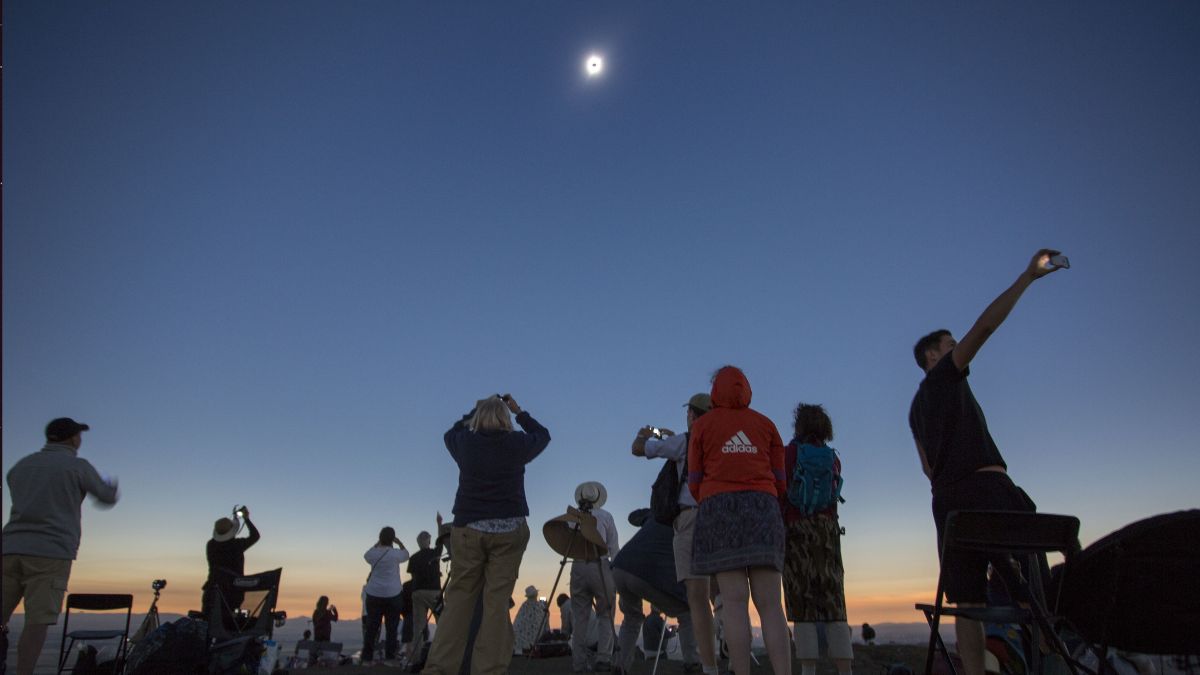 People witnessing Solar Eclipse (Image: Space)
* This is the first solar eclipse of the year 2026.
* Later in the year, it is followed by a total solar eclipse on August 12, 2026.
* Annular eclipses are relatively rare, and because of that, especially valuable to astronomers for the great visual ring.
* Since the path traverses remote regions, including Antarctica, only a few places will experience the annular phenomenon in its entirety.
Safety Tips while watching Solar Eclipse
* Never look at a Sun directly with your bare eyes.
* Use ISO-certified solar viewing glasses or solar filters on telescopes or cameras.
* Consider live streams/scientific broadcasts for eclipse viewing, even if it’s not visible in your local area.