
- By Deeksha Gour
- Fri, 23 Jan 2026 01:20 PM (IST)
- Source:JND
Smog Stories: Delhi's air is often loaded with fine particles (PM2.5) and toxic gases that can seep deep into the lungs. Paradoxically, people who are young, fit and exercise outdoors may inhale more of these pollutants and suffer damage similar to that caused by smoking. While common belief suggests that staying fit and avoiding tobacco offers protection against respiratory illness, medical data from Delhi-NCR hospitals tells a different story. Today, marathon runners, regular gym-goers and lifelong non-smokers are increasingly reporting to clinics with lung damage once seen almost exclusively in heavy smokers.
Why Delhi’s pollution hits the young and fit harder
Doctors explain that the “young and fit” are often at greater risk during severe smog episodes. During exercise, breathing rate and lung volume increase sharply. A sedentary person at rest inhales around 6-10 litres of air per minute, but during high-intensity workouts, a fit individual’s air intake can rise to nearly 100 litres per minute. In a city where pollution levels frequently exceed safe limits, this means a significantly higher dose of harmful particles entering the body, leading to acute inflammation and long-term lung damage.-1769154145890.jpeg "Smog stories: Excercising in toxic air (AI Generated)")
When the AQI crosses 300, these deeper and faster breaths act like a high-speed vacuum, pulling fine particulate matter past the body’s natural filters in the nose and throat. These microscopic particles reach the alveoli and can even enter the bloodstream, triggering widespread inflammation. In effect, exercising in toxic air results in the lungs being exposed to a concentrated dose of pollutants, as per a Scientific Reports study.
The hidden danger for gym-goers
While outdoor workouts pose the highest risk, indoor gyms are not always safe alternatives. Many commercial gyms lack medical-grade HEPA filtration. Combined with poor ventilation, high carbon dioxide levels and recirculated polluted air, enclosed workout spaces can turn into what doctors describe as a “toxic trap”. -1769154201544.jpeg "Smog stories: Hidden dangers at gym")
Some pulmonologists warn that intense outdoor running during peak smog can be equivalent to smoking nearly a pack of cigarettes in a single session. Studies show a measurable drop in Forced Expiratory Volume (FEV), a key indicator of lung function, even in elite athletes who may not experience immediate symptoms. High-intensity cardio further increases inhalation, adding cardiovascular strain, prompting experts to advise skipping strenuous workouts on days when AQI levels remain high.
Non-smokers showing ‘smoker-like’ lung damage
Doctors in Delhi say lung cancer is no longer limited to smokers. Hospital data shows a sharp rise in cases among people with no history of smoking or tobacco use, including women and younger patients. In 1998, nearly 90 per cent of lung cancer patients were smokers, but by 2018, non-smokers accounted for an estimated 50–70 per cent of cases, as per a Times Of India report.
Pathologists are also observing a rise in adenocarcinoma, a lung cancer subtype closely linked to environmental exposure rather than tobacco use. During surgeries, doctors increasingly report “blackened lungs” in non-smokers — a result of prolonged deposition of carbon particles and heavy metals from polluted air, a condition once associated mainly with coal miners and chronic smokers.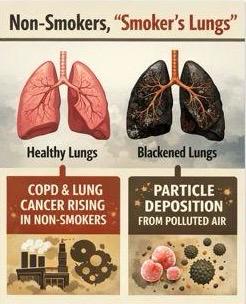
ALSO READ: Smog Stories: Can Delhi's Polluted Air Cause Cancer? What Experts And WHO Findings Reveal
What doctor says
The Daily Jagran spoke to, Dr Biswadip, Respiratory Medicine, Manipal Hospital, Kolkata, to understand health risks posed by air pollution. He stated that persistent coughing is one of the earliest warning signs of pollution-related lung damage. People with existing lung conditions often see their symptoms worsen, while even healthy individuals may develop a sudden cough and throat irritation after prolonged exposure to polluted air.
He advised that wearing a mask while stepping out, especially in traffic, is crucial. “When the AQI crosses 200–250, people should avoid going outdoors, as the air becomes unhealthy for everyone. Staying indoors is safer, and air purifiers can help in small, enclosed rooms. At AQI levels of 450–500, the air is unsafe for all, and strong government measures are needed,” he added.
Conclusion
In Delhi’s smog, fitness alone is not protection. When pollution levels rise, even non-smokers and regular exercisers risk lasting lung damage simply by breathing more deeply. Until air quality improves, reducing exposure is as critical as staying active.