
- By Raju Kumar
- Tue, 10 Feb 2026 05:45 PM (IST)
- Source:JND
Lok Sabha Speaker Impeachment: The stalemate between the government and the Opposition in the Lok Sabha escalated to the no-confidence motion (impeachment) for the lower house chairperson Om Birla. All major opposition parties submitted a no-confidence motion in the House. 118 MPs, except Mamata Banerjee's TMC members, from the Opposition camp signed the notice. The Lok Sabha Speaker directed the Secretary General to examine the notice served for moving a resolution to remove him from office.
What TMC Said On Not Joining The Oppn Camp
TMC said that the party will sign on the no-confidence motion if the Speaker does not act on the Opposition's appeal within two to three days. TMC MP Abhishek Banerjee said, "Even yesterday we made it clear that all the TMC MPs will sign the no-confidence motion resolution, but our suggestion to them was that the issues, including suspension of MPs, LoP not being allowed to speak, women MPs being falsely accused and that the Chair is working in a biased manner." Sources in the Lok Sabha Secretariat said the notice will be examined and processed according to rules.
What Is The Procedure To Impeach Lok Sabha Speaker?
According to the norms, at least two Lok Sabha members have to sign the notice to move a resolution for the Speaker's removal. Any number of members can sign the notice, but a minimum of two is mandatory.
The Speaker can be removed from office by a resolution passed by the House through a simple majority. Article 94C of the Constitution has provisions for such a move.
"All the members of the House are counted to compute the majority, not the members present and voting, which is the normal practice. It means the effective membership of the House, except the vacancies, is used to calculate the majority," former Lok Sabha secretary general PDT Achary said.
Here Are The Highlights Of The Procedure
- The notice has to be submitted to the Lok Sabha secretary general, and not the deputy speaker or anyone else.
- The document is then examined at the preliminary stage to see whether it contains very specific charges.
- At the threshold itself, there is a process of admissibility. At that stage, it is seen whether it contains specific charges. Specific charges are required as only then the Speaker will be able to respond.
- The resolution must not contain defamatory language or content.
- Article 96 gives the Speaker the opportunity to defend himself or herself in the House.
- The language of the proposed resolution is usually examined by the deputy speaker, but since the present Lok Sabha does not have a deputy speaker, it may be examined perhaps by the senior-most member of the panel of chairpersons.
- The panel helps the Speaker run the House in his or her absence.
- The Speaker examining a resolution that seeks his removal looks absurd. The rule is silent on the subject.
- Once the processing part is over, the resolution reaches the House. But it can go to the House after 14 days.
- The Speaker then places it in the House for consideration. It is actually the House which admits it, or as the rule says, "grant permission".
- The Speaker then asks members in favour of the resolution to stand up. If 50 members stand up in support of it, if the criteria are fulfilled, the Speaker announces that the House has granted permission.
- Once the House grants permission, it has to be taken up for discussion and disposed of within 10 days.
- There are precedents of resolutions being moved. However, none has been adopted so far.
Has Any Speaker Been Impeached In Past?
No, no Speaker has ever been successfully removed from office through impeachment in the history of the Lok Sabha. The reason is evident. In terms of numbers, the ruling party has always advantage in the House, and during the voting, the government defeats Opposition's impeachment notice.
Unsuccessful Efforts To Impeach Speakers In Past
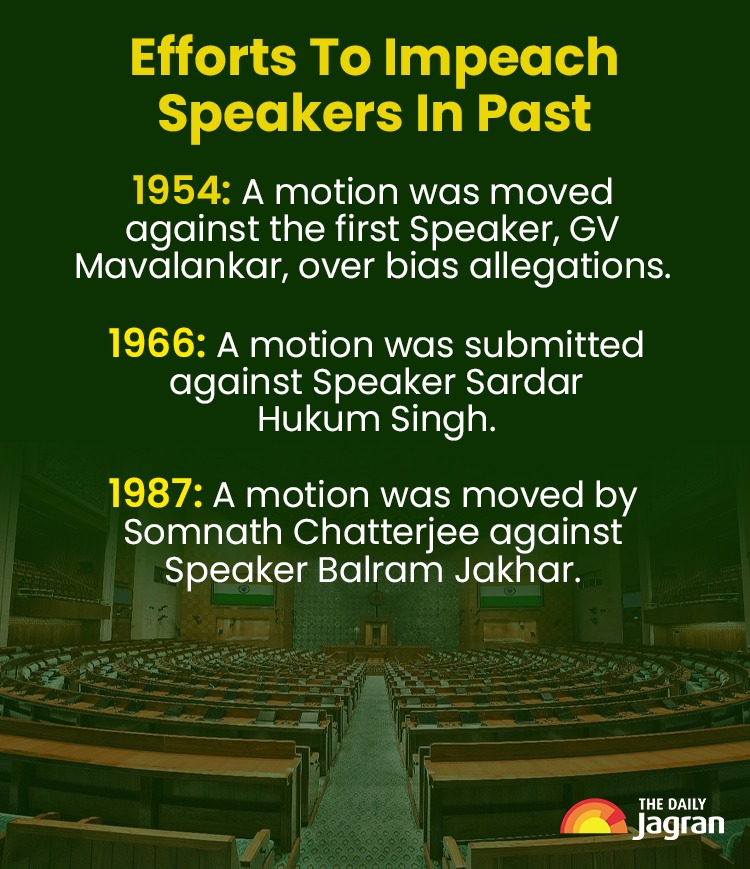
1954 (1st Lok Sabha): A motion was moved against the first Speaker, GV Mavalankar, over bias allegations. The Lower House debated and rejected it.
1966: A motion was submitted against Speaker Sardar Hukum Singh, but it was not taken up as it lacked the support of at least 50 members. It was moved in the Lok Sabha by socialist leader Madhu Limaye.
- 1987: A motion was moved by Somnath Chatterjee against Speaker Balram Jakhar, but the House rejected it. Later, Chatterjee himself became the Speaker of the Lok Sabha from 2004 to 2009.
(With agencies' inputs)