
- By Shubham Bajpai
- Mon, 23 Feb 2026 06:48 PM (IST)
- Source:JND
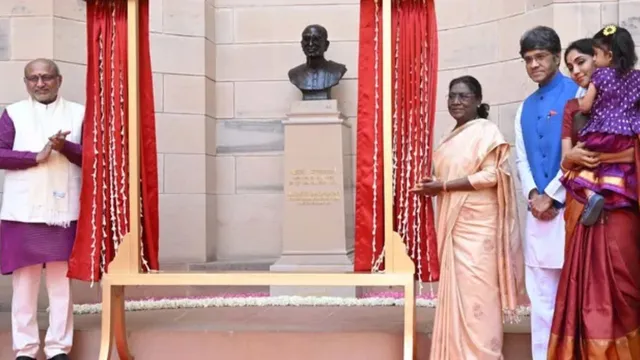
President Draupadi Murmu on Monday unveiled the statue of Chakravarti Rajagopalachari (Rajaji), the country's first Governor General, replacing British architect Edwin Lutyens, in the central courtyard of Rashtrapati Bhavan.
Vice President CP Radhakrishnan and several Union ministers were present at the ceremony. Rajaji Utsav was also celebrated today, and an exhibition on Rajagopalachari will be held from Tuesday, February 24, to March 1. Prime Minister Narendra Modi mentioned this change during the 131st episode of "Mann Ki Baat."
What's behind the change?
The central government has brought the change to convey a message of respecting the country's national symbols and shedding colonial-era legacies, while also prioritising prominent figures associated with the Indian leadership.
Speaking at the event, President Murmu said, "As we move ahead towards making 'Viksit Bharat' by 2047, icons like Rajaji inspire us with their ideas and ideals. Let us resolve to promote the spirit of enterprise to fulfil the dreams of Rajaji."
Who was Rajaji?
- Chakravarti Rajagopalachari is popularly known as 'Rajaji'.
- He was born on 10 December 1878 in Madras Presidency.
- He succeeded Lord Mountbatten in 1948 and served as the last Governor-General of India until the office was abolished in 1950.
- He was also the first and only Indian to hold the office.
- He was a close associate of Mahatma Gandhi, participating in the Non-Cooperation and Civil Disobedience Movements.
- During Mahatma Gandhi's imprisonment, he edited Young India and later founded the Swatantra Party in the year 1959.
- He was a leader of the Indian National Congress and the Governor of West Bengal when the Bengal province was divided into two parts.
- Outside of politics, he translated the Ramayana and the Mahabharata into English and Tamil. He was awarded the Bharat Ratna in 1954.